
At Winterbourne House and Garden, working with undergraduate and postgraduate students is one of the perks of the job. We’re always delighted when tutors come to us asking for access to our museum collections, and students on a wide range of courses have engaged in object-based learning here.
‘Turning the Pages’ is a module offered to Art History students at the University of Birmingham. It aims to introduce students to the history of printing and the process of making books. The Winterbourne Press was the obvious destination for a visit, and the group had a demonstration from Lee Hale on some of our historic printing presses. They saw the process at first hand, from compositing and ‘locking up’ to inking and printing and also viewed our enormous Heidelberg press and Linotype machine.
Following their experience in the press, the students got their hands on some of our museum objects. I brought out a range of items, from eighteenth-century volumes to twentieth-century limited edition books, but alongside these I showed them some of the simple printing techniques that people had access to before the days of digital printing.
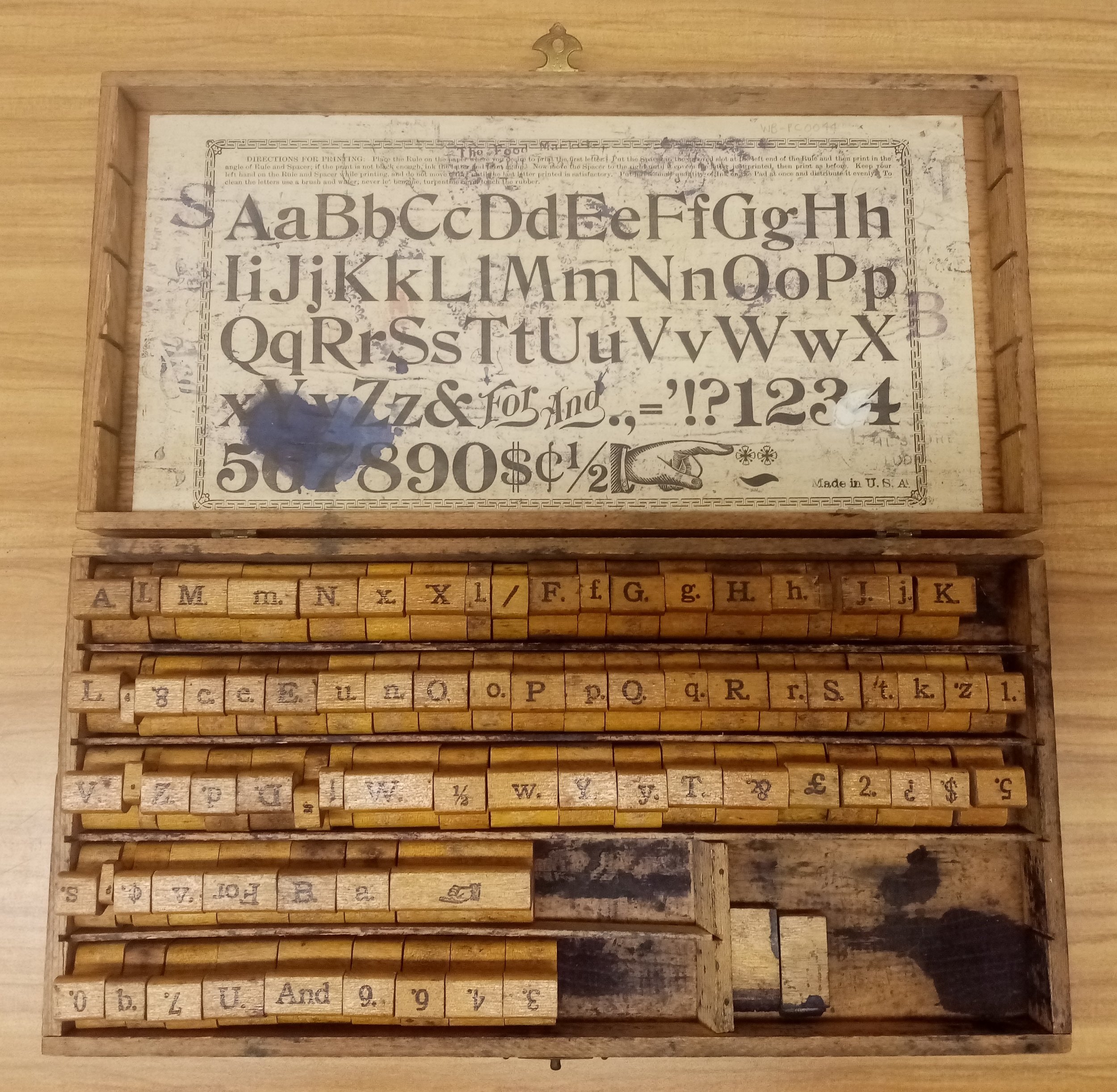
The Taylor family ran a grocery shop in West Bromwich Street, Walsall from the 1930s onwards. When they needed a notice to highlight a special offer or a new product, they used a Barrett printing kit. The kit contains rubber stamps, covering the alphabet and a range of symbols and phrases that a shop might need, from ‘Special Value’ to ‘Finest Quality’. This set, along with ink pads and another set of rubber alphabet stamps, remained in the family until the Taylors’ granddaughter donated them to Winterbourne.
A similar American printing set contains the same range of stamps, and the label inside the lid shows evidence of trial printing, along with ink blots! Both these printing sets bear the scars of long and repeated use.
We recently acquired a set of alphabet blocks made of brass mounted on wood. These beautiful blocks are works of art in themselves! They come with a ruler, which has apertures for the blocks to ensure a straight and correctly-spaced line of print.
Those of us who remember the 1970s and 1980s will be familiar with another means of home ‘printing’—Letraset transfer sheets. We have in our collection a cardboard box full of Letraset sheets in a wide variety of founts. For students in their teens and twenties, Letraset is a mystery; it’s almost as remote from their world as an 1830s printing press.
The ‘Turning the Pages’ module gave us a great opportunity to bring some of these objects out of store and enable students to examine them up close.
Henrietta Lockhart, Curator, Winterbourne House and Garden