
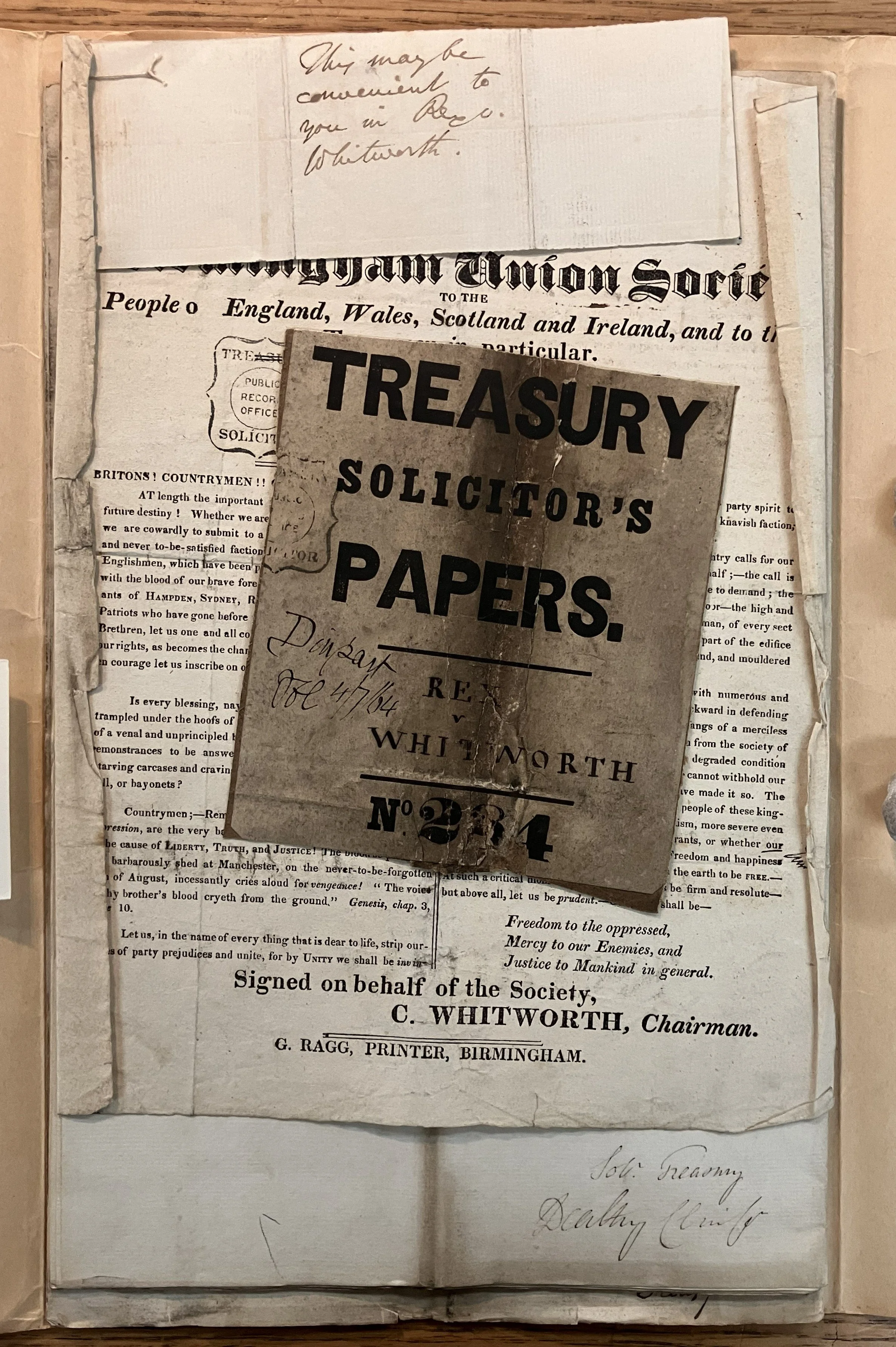
Between 10-13 November I undertook a research trip to The National Archives, Kew to examine the Home Office and Treasury Solicitor Papers pertaining to the radical movement in Birmingham between 1815-22.
The papers contain correspondence between Birmingham magistrates and the government, regarding radical activity in the town – most of the radicals mentioned were printers, vendors or proprietors of radical print.
The archives also contain several numbers of Birmingham radical newspapers that do not survive anywhere else.
My thesis examines the material evidence found within Birmingham’s early nineteenth century radical press, and exposes the practicalities built into the everyday experiences of newspaper printers in the town. The prosecutions and legal loopholes the radical press had to navigate had a profound effect on the publication and appearance of their printed outputs – as such, examination of the Home Office and Treasury Solicitor’s papers was a crucial aspect of my research.
The trip to TNA was a complete success. All of the research and preparation I carried out prior to my visit proved incredibly useful. It meant that I was able to get through all the documents I wanted to consult and had time on the final afternoon to order a few extra pieces of correspondence.
I located several copies of the radical newspapers in their original state (i.e. not bound and trimmed to fit into a library collection). Some hadn’t been tied and others weren’t completely cut so I was able to unfold them and confirm how they would originally have been laid on the forme. This reveals more about the mechanics of the printing – how they operated the press and their workflows. I was able to take detailed measurements and examine the material aspects in minute detail. Another of the newspapers I’m examining still retained its original advertising wrappers – which will help me place, with certainty, the other adverts I’ve located in bound volumes in their correct order (until now I have only been able to make an educated guess).
This was the first time I had encountered any of the newspapers in their original state – I was finally able to understand how the radical’s contemporaries would have experienced reading them. I also found another, unlisted number of the Birmingham Argus, hidden in some Treasury Solicitors Papers (I have so far only located two other complete numbers). I also located several other items of radical print created by the Birmingham radical printers that previously I had only been able to read about. There were also several copies of Lewis’s Coventry Recorder – a very scarce newspaper. It is printed by one of the Birmingham radicals and is almost identical in format, layout and type to one of the newspapers I’ve been researching.
I photographed a huge number of legal papers concerning the prosecutions of the radical printers – from what I’ve encountered so far, these contain numerous details about the printers – where their shops were, how they made profits, who they employed etc.
The findings from this research trip have yielded several new avenues to explore and have provided crucial insights into aspects of Birmingham’s radical printers’ lives which I would otherwise never have been able to ascertain. I’m very much looking forward to working through it all, and to begin constructing a detailed narrative of the lives and practices of Birmingham’s early nineteenth century radical printers. This trip allowed me the space and opportunity to conduct a thorough examination of the pertinent documents at TNA, the findings of which will prove transformative to the outcome of my thesis.
© Andie Lloyd, M4C Doctoral Candidate