One cannot tell where one’s work begins and ends; in fact there may be no end, for goodness and truth abide forever. leonard jay
This year marks 100 years since Leonard Jayl became the first head of the Birmingham School of Printing, which was located both at Vittoria Street and Margaret Street. This short article, original published in the Oxford Dictionary of National Biography, pays tribute to the man and his work.
Jay, Leonard (1888–1963), printer and teacher, was born at Broad Street, Bungay, Suffolk, on 7 June 1888, the second son of Leonard Jay (1864–1939) and his wife, Alice Emma Mary, née Weavers (1864–1924). The family was steeped in printing. His father worked as a stereotyper at the local printing firm of Richard Clay, which also provided employment to his uncles and aunts. In 1889 Jay’s father took up an appointment at Oxford University Press before moving in 1893 to a printing office in London. Having attended higher elementary school at Stroud Green, Jay was indentured, on 5 June 1905, as a compositor to Thomas Thompson Hodgson, educational printers in High Holborn.
Jay supplemented his workshop experience with formal technical education at the Aldenham Institute, St Pancras, where W. H. Amery ran classes in letterpress printing. Jay was an outstanding student. In 1907 he was awarded a Junior Artisan Art Exhibition; and in 1909 he won an Artisan Art Scholarship entitling him to three years’ free tuition at the London County Council Central School of Arts and Crafts, Holborn. Here he enrolled on the newly established typography evening classes run by the printer-scholar John Henry Mason; attended Edward Johnston’s calligraphy classes; and embarked on engraving classes under Bernard Adeney. In 1912 Mason appointed Jay as his first assistant instructor.
On 1 August 1914, Jay married Emily Annie (1886–1973), daughter of Anthony Allen, builder. They had a daughter (born in 1916) and a son (born in 1918). Jay attested for service during the First World War and was placed in the Army Reserve, while continuing his occupation as a technical teacher in London.
Jay was neither a disciple of his mentor Mason’s aesthetic philosophy nor a servant to his pedagogical practice. While Mason taught the production of fine edition bookwork using traditional hand-processes, Jay believed such training was an anachronism in the new climate of competitive industrialism. He understood if technical education was to succeed it had to work with existing trade practices, and he therefore introduced students to the everyday challenges of commercial printing and demonstrated that quality bookwork could be produced using modern machinery. His attempts at teaching reformation were rewarded when, in 1923, the Mid-Kent Regional Education Authority invited him to establish printing classes in Maidstone. In 1925, he was given further opportunity to apply his educational methods when he was appointed the first Head of the City of Birmingham School of Printing, the largest centre of printing outside London.
Jay understood that the increasing mechanization of printing meant the local trade needed apprentices who had received a wider and more general education before entering the craft. To address this he took the radical step of establishing a pre-apprentice course whereby boys, aged between twelve and sixteen, were prepared for employment in the printing industry. Admission to the School was though an entrance examination and successful applicants attended the School full-time for three years before taking up apprenticeships locally. This was a significant departure in the training of printers who had traditionally been admitted to the trade through familial contacts and were trained ‘on the job’ under the guidance of a Master Printer. Jay’s pre-apprentice classes enabled boys to enter the trade on merit rather than preference and to acquire prior knowledge of the craft while at school.
The classes were welcomed by Birmingham’s printing industry as they guaranteed a supply of well-educated apprentices who were also familiarized with the rudiments of printing. On the other hand, the local trade unions opposed Jay’s pre-apprentice classes. In particular, the Birmingham Typographical Association resisted Jay’s scheme because it displaced the old preferential system depriving men already in the industry of the automatic right to apprentice their sons. It also feared that the agreed quota of apprentices would be exceeded through the shorter term of apprenticeship served by boys from the School, and this would jeopardize its members’ livelihood. Jay proved the claims to be unfounded, yet the Association continued to oppose Jay for more than twenty years.
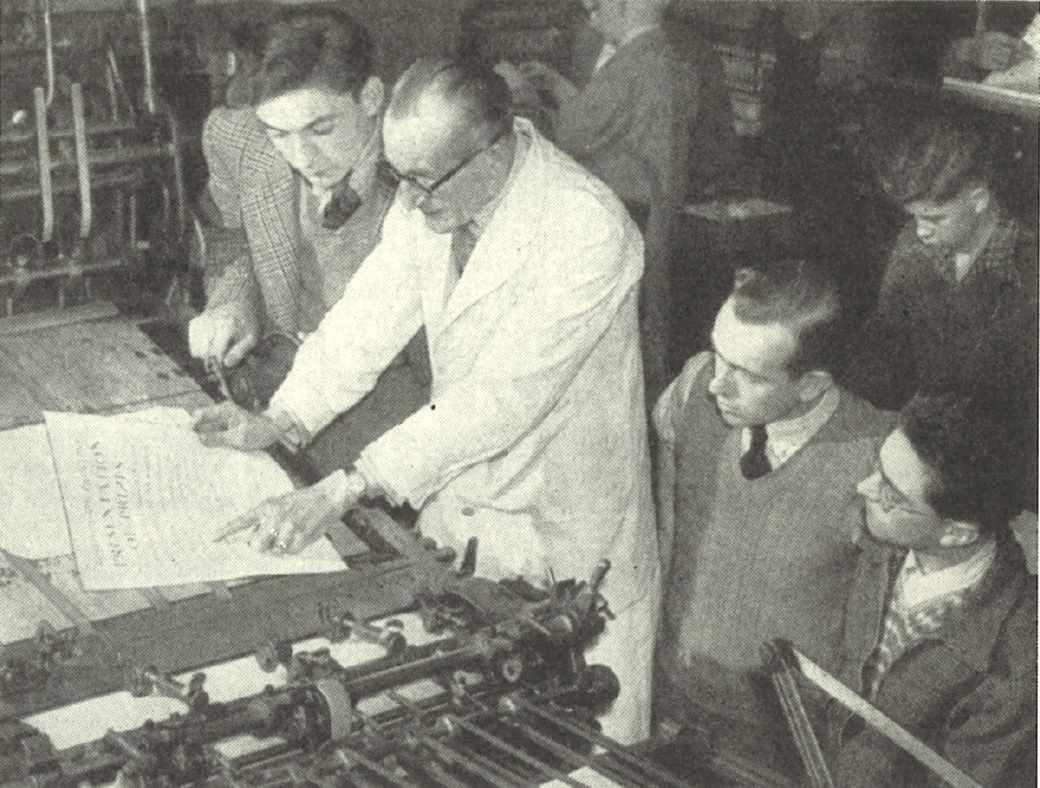
While many schools of printing continued to teach traditional hand techniques, Jay at Birmingham installed modern machinery, including Monotype and Linotype composing machines and Miehle printing presses. To introduce technology into an art school was a courageous move in the 1920s when many institutions still subscribed to the philosophies of the Arts and Craft movement and viewed technology with suspicion. Jay, however, believed that the products of mechanical printing could be improved when its creators were given the intellectual wherewithal to breathe beauty into the products of the machine. He understood that printing had become increasingly accurate as a result of improvements in technology, but machines were of little use without the human factor, which would enable better quality design and production. He had no doubt that better-trained apprentices who had acquired all those artistic qualities necessary in good printing would be able to produce work equal to that done by hand, and at the same time more economically.
Jay advocated the application of fine printing standards to commercial jobbing work. He believed that nothing worth printing was too small, humble, or inconsequential to be well designed and that every job deserved the highest possible standards of composition and presswork. Through an innovative publishing programme, Jay provided all students with the opportunity to produce at least one piece of work of great distinction of which they could be justly proud. The first book produced by his students was a passage from The Book of Ecclesiasticus, ‘Let us now praise famous men’ (1926), which was followed by over 150 publications, the last of which was the Collects and Gospels from the Book of Common Prayer (1953). The Torch (1933–50), an innovative vehicle for displaying the work of the School, was a substantial, intermittent publication, which contained samples of both book and jobbing work produced by the students. The work won praise throughout the world for its high-quality design and production, use of contemporary typefaces, and modern methods of production.
When Jay began his work at the Birmingham School of Printing, he was the only full-time teacher on the staff, and there were just two half-day classes a week. At his retirement in 1953, more than 530 students attended the School, and there were seventy-four classes. He had transformed the education of a whole generation of printers, who took his teachings into the industry not only locally but also nationally and internationally; some went on to become teachers themselves, occupying positions of influence. He retired to Sussex where he died at his home, 3 King’s Court, Aglaia Road, Worthing, on 3 June 1963.
leonard jay archives
Several archives in the city have holdings relating to the work of Leonard Jay, including:
biad archives: School of Printing minutes of meetings
Cadbury Research Library: Priavte letters of Leonard Jay
Birmingham & Mildand Institute: books and ephemera produced by students at the School of Printing
Typographic Library, Winterbourne House: books and ephemera produced by students at the School of Printing
© Caroline Archer-Parré, Dictionary of National Biography