
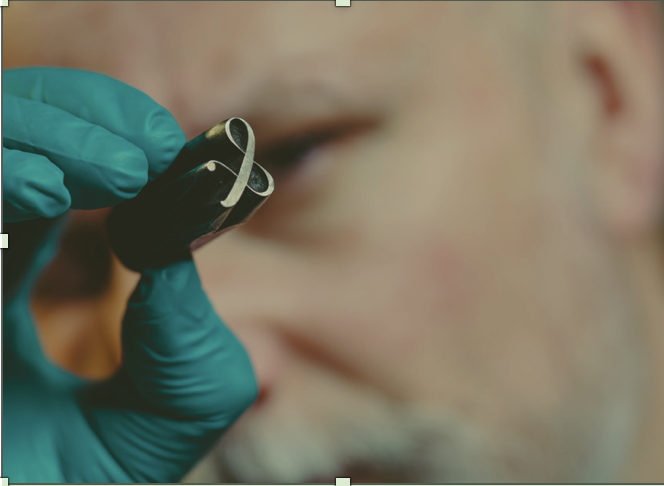
Hundreds of rare steel punches used to create the original Baskerville typeface have been digitised and made freely available online, allowing unprecedented insight into the work of one of Britain’s most influential printers. The punches, cut by hand in the eighteenth century and used to manufacture the metal type for John Baskerville’s printed books, can now be examined in extraordinary detail thanks to the major research project Small Performances, led by Birmingham City University and the the University of Cambridge.
By launching this digital collection, the project is transforming access to this unique archive. Designers, historians and the wider public around the globe now have the opportunity to study the physical tools behind a typeface that helped shape modern typography.
Professor Marcos Martinón-Torres (University of Cambridge): ‘Baskerville’s punches mark a revolution in both visual design and materials engineering. His workshop transformed the world of printing, and the characters we encounter on our screens today still carry his influence. These punches continue to inspire and challenge heritage scientists, typeface designers, printers, and craftspeople alike. The quality of this digital resource is unparalleled, made possible through an extraordinary collaboration committed to open science.’
THE MAN BEHIND THE MARKS
Baskerville, who opened his Birmingham printing workshop in 1750, was driven by a desire to improve the quality of printed books. He produced attractive editions of classical and English literature, including works by Virgil and Milton. Although his books were admired across Europe and America, he was initially dismissed by Britain’s printing and publishing trade as an amateur and a provincial. However, he persevered and in 1758 was appointed University Printer at Cambridge. There, he produced his most celebrated work: a lavish folio Bible published in 1763, still regarded as one of the most beautiful books ever printed.
The newly launched online collection focuses on the tools that made such works possible. Each steel punch was cut by hand, hardened, and struck into copper to form a matrix from which metal type was cast. The majority of the 3,000+ punches are believed to date from Baskerville’s lifetime.
HERITAGE SCIENCE UNLOCKS NEW SECRETS
Using a technique known as Reflective Transformation Imaging (RTI), researchers on the Small Performances project have captured microscopic surface details, revealing the marks left by punch cutters and metalworkers. These traces offer a rare opportunity to study crafts that have largely disappeared.
Maciej Pawlikowski, Head of Cultural Heritage Imaging Laboratory at Cambridge University Library, explains: ‘Preparing images for the Cambridge Digital Library collection pushed us to develop new ways of approaching heritage photography. The main aim was to create a resource which, as well as being informative to historians and designers, can also offer insight to contemporary craftspeople. The traditional photographs and newly developed 2.5D dynamic viewer (RTI) give users the opportunity to examine the marks left by the punchcutter beyond what’s possible with the naked eye. The project has created a unique opportunity for modern day craftspeople to reconnect with the methods from the past, which were previously lost to the community.’
A newly developed online viewer, launched alongside the digital collection, allows users to interact with the images resulting from the RTI analysis and explore engraving techniques and surface textures in remarkable detail.
Through the analysis, the project team have developed new understandings into Baskerville’s work and his experimentation over time.
Dr Caroline Archer-Parré, Co-Director of CPHC, Birmingham City University: ‘Through the exciting opportunity to investigate the Baskerville punches, we have a closer understanding of the man who made them than ever before. We now understand making the punches was a two-way process as Baskerville responded to his typographic creations by modifying them over several years. This is important because it demonstrates his typeface was neither static nor fixed. Now we know that there is not one ‘original’ Baskerville, but multiple originals which evolved over time. Discovering the punches is like finding the source of the Nile, they are the fount (both literally and metaphorically) from which all successive Baskerville-inspired typefaces have sprung.’
A COLLECTION TO INSPIRE FUTURE GENERATIONS
After Baskerville’s death in 1775, the punches passed through multiple owners before being rediscovered in the early twentieth century. In 1953, thousands of them arrived at Cambridge packed into oak boxes, donated by the French type foundry Deberny & Peignot. The punches are now owned by Cambridge University Press & Assessment and housed in the collections of Cambridge University Library.
By making the collection openly available on Cambridge Digital Library, the project is ensuring Baskerville’s influence will continue to inform and inspire contemporary designers, printers and historians around the world.
Explore the digital collection
Discover more about how the RTI viewer was developed
The ‘Small Performances’ Team, Birmingham City University & University of Cambridge